Innovation leaders who are hiring just for AI skills are getting it all wrong.
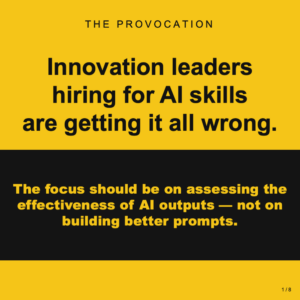
The focus on integrating AI into innovation shouldn’t be on the skills needed to create effective inputs, it should be on the skills to assess the effectiveness of AI outputs. The question is whether your leaders have the judgment to know when AI is right — and when it’s just confidently reinforcing a bad decision.
For most of the history of innovation, a leader’s value was inseparable from their ability to create. To move from blank page to breakthrough concept. To generate the ideas others couldn’t.
AI just made that skill abundant.
Today, almost anyone with basic training can produce a compelling product concept, a persuasive narrative, a viable design. The creative floor has risen dramatically. What was once rare is now accessible.
But here’s the catch.
AI doesn’t just raise the floor. It also narrows the ceiling. Left uncurated, AI gravitates toward the plausible and the familiar. AI doesn’t actually create, it synthesizes remixes and mash-ups. It optimizes toward the expected. And it has no idea what it doesn’t know.
It can’t tell you whether the idea actually solves the problem. Whether it fits your strategy. Whether it accounts for what your customers won’t say in research. Whether it will sell. Whether the team missed something obvious. Whether you’re the tenth company to try this exact approach.
AI will always give you a compelling answer with confidence, regardless of how bad, derivative, obvious or ill considered it is for the challenge to be solved. That’s the danger.
The new job of innovation leadership isn’t generating ideas. It’s exercising judgment across a much wider and faster-moving set of decisions than leaders have ever faced before.
Is this the right problem to solve? Is the output genuinely good, or does it just look good? What is AI not accounting for? Where is it amplifying my team’s existing blind spots?
Creation was always the visible part of the job. Judgment was always the more important part.
AI just made that impossible to ignore.
The innovation leaders who thrive won’t be the ones who use AI to produce more. They’ll be the ones who make the best decisions about what AI produces.
That skill is far more rare and harder to assess than it sounds. Traditionally, leaders built that judgment over years of incremental decision-making — learning what good looks like by being wrong enough times to know. With AI, those same decisions land on day one of an innovator’s career.
There is no silver bullet that can show if a leader is as good a decision-maker using AI outputs as they were with traditional innovation processes. There’s no way to assess the decision-making capabilities of team members before it matters. The only way to give an innovation leader the best chance to make the best decisions is through preparation.
The way to prepare for that is to define success criteria and stress-test strategy before anyone writes the first prompt. Get aligned on what you’re solving for, what the strategic guardrails are, and what tradeoffs you’re not willing to make. Then let AI run.
Stop hiring for prompting skills. Start hiring for judgment. That’s always been the job. AI just made it the only job that matters.
This is one of the ways leaders F-Up innovation. There are 12 others.
📖 How Leaders F-Up Innovation by Marc Drucker
🔔 Follow for more: https://www.linkedin.com/company/how-leaders-f-up-innovation
📬 Newsletter: https://howleadersfupinnovation.com/wp/signup/
Innovation #Leadership #AI #HowLeadersFUpInnovation #ArtificialIntelligence